# steps to create fake data from a distribution
# and conduct t-tests on the simulated data
save_ps <- length(1000)
save_ts <- length(1000)
for (i in 1:1000) {
  my_sample <- rnorm(n = 30, mean = 50, sd = 25)
  t_test <- t.test (my_sample, mu = 50)
  save_ps[i] <- t_test$p.value
  save_ts[i] <- t_test$statistic
}
Section 6.5 Simulating data for t-tests
If you recall, \(t\) is a property of a sample. We calculate \(t\) from our sample. The \(t\) distribution is the hypothetical behavior of our sample. That is, if we had taken thousands upon thousands of samples, and calculated \(t\) for each one, and then looked at the distribution of those \(t\)’s, we would have the sampling distribution of \(t\text{!}\)
It can be very useful to get in the habit of using R to simulate data under certain conditions, to see how your sample data, and things like \(t\) behave. Why is this useful? It mainly prepares you with some intuitions about how sampling error (random chance) can influence your results, given specific parameters of your design, such as sample-size, the size of the mean difference you expect to find in your data, and the amount of variation you might find. These methods can be used formally to conduct power-analyses. Or more informally for data sense.
Subsection 6.5.1 Simulating a one-sample t-test
Here are the steps you might follow to simulate data for a one sample \(t\)-test.
-
Make some assumptions about what your sample (that you might be planning to collect) might look like. For example, you might be planning to collect 30 subjects worth of data. The scores of those data points might come from a normal distribution (mean = 50, sd = 10).
-
sample simulated numbers from the distribution, then conduct a \(t\)-test on the simulated numbers. Save the statistics you want (such as \(t\)s and \(p\)s), and then see how things behave.
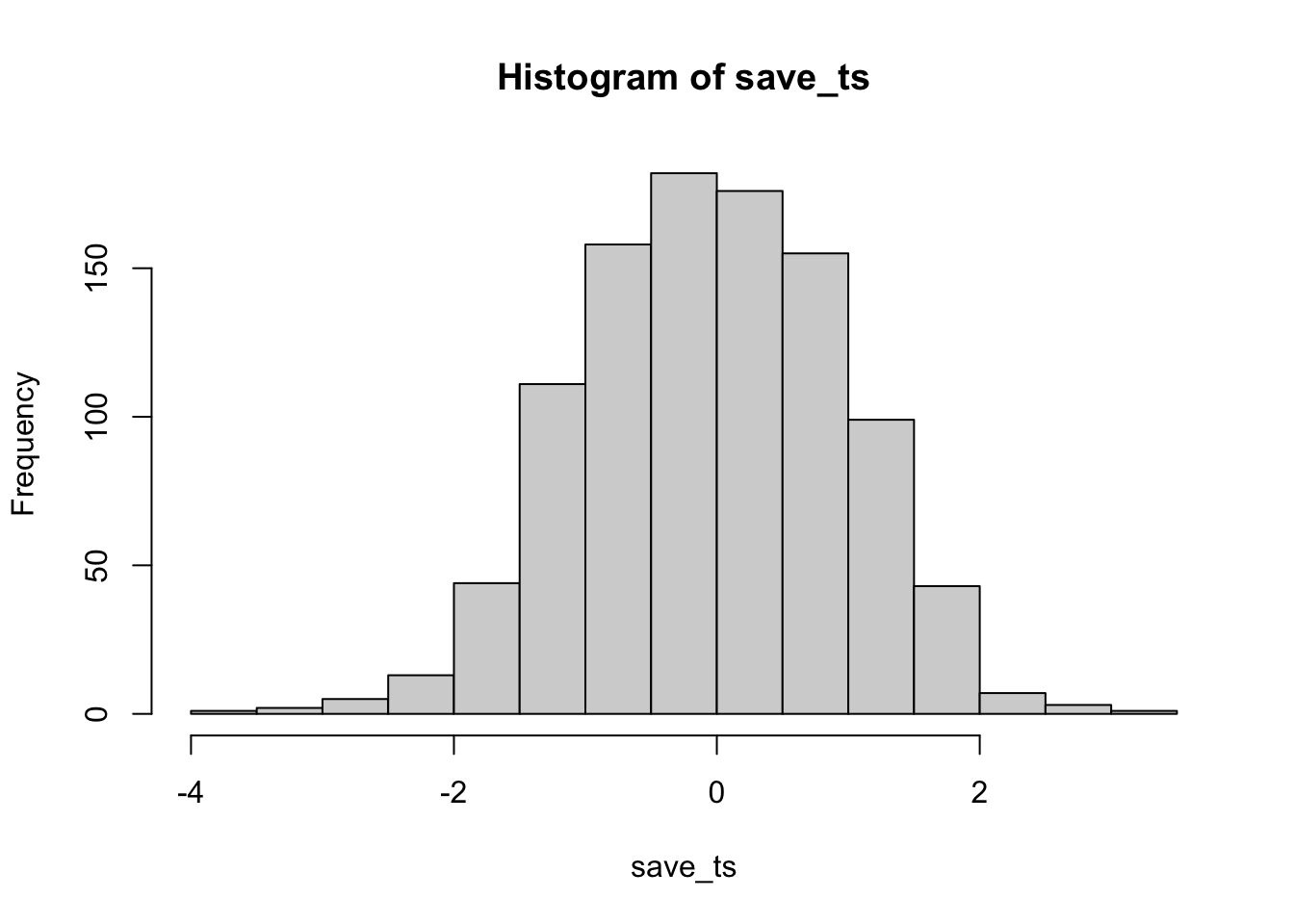
Let’s do this a couple different times. First, let’s simulate samples with N = 30, taken from a normal (mean= 50, sd = 25). We’ll do a simulation with 1000 simulations. For each simulation, we will compare the sample mean with a population mean of 50. There should be no difference on average here. Figure 6.5.3 is the null distribution that we are simulating.
Remark 6.5.1. R Code.
Remark 6.5.2. R Code.
hist(save_ts)
Remark 6.5.4. R Code.
hist(save_ps)
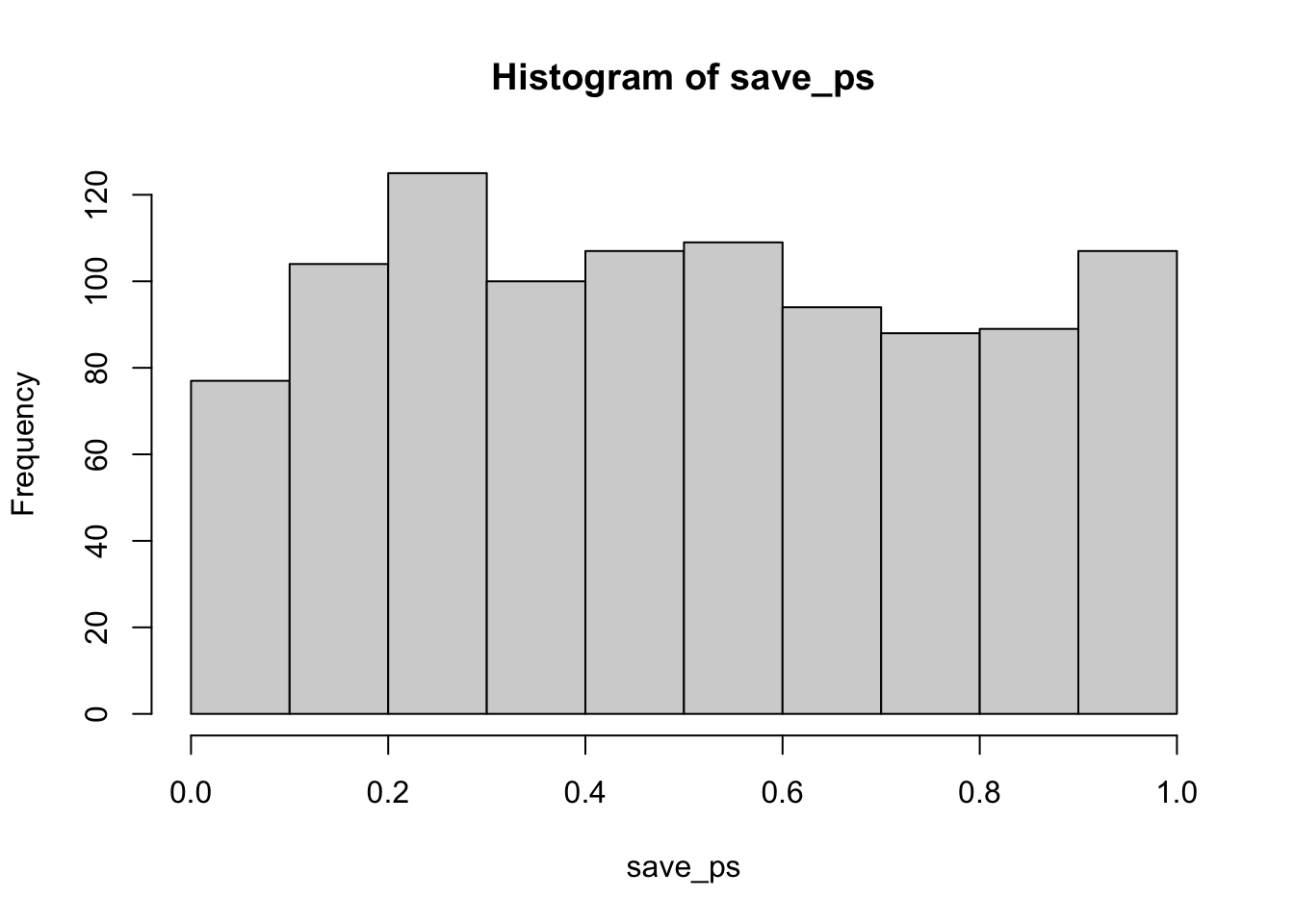
Neat. We see both a \(t\) distribution, that looks like \(t\) distribution as it should. And we see the \(p\) distribution. This shows us how often we get \(t\) values of particular sizes. You may find it interesting that the \(p\)-distribution is flat under the null, which we are simulating here. This means that you have the same chances of a getting a \(t\) with a p-value between 0 and 0.05, as you would for getting a \(t\) with a p-value between .90 and .95. Those ranges are both ranges of 5%, so there are an equal amount of \(t\) values in them by definition.
Remark 6.5.6. R Code.
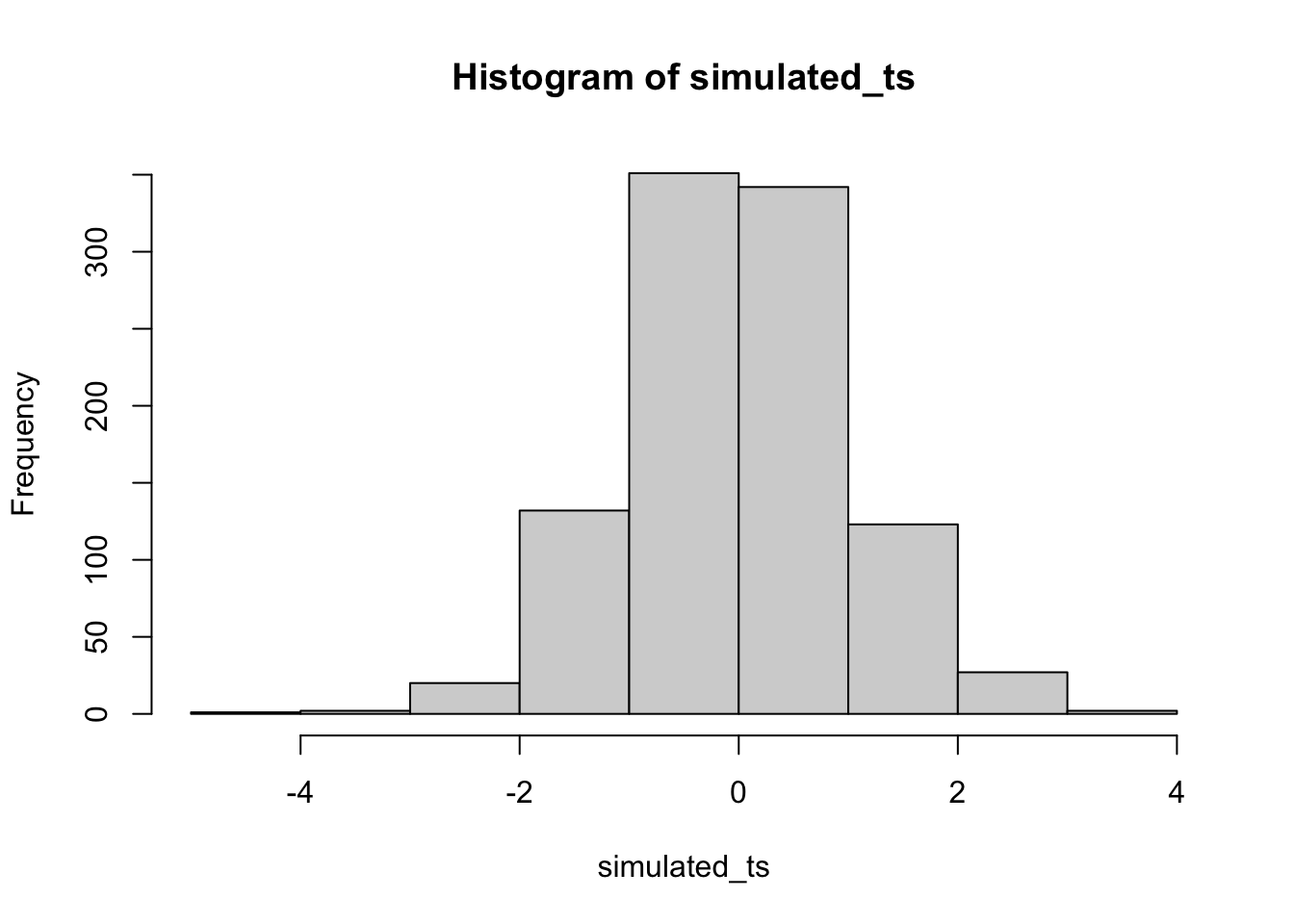
simulated_ts <- replicate(1000,
                          t.test(rnorm(30, 50, 25), mu = 50)$statistic)
hist(simulated_ts)
Remark 6.5.8. R Code.
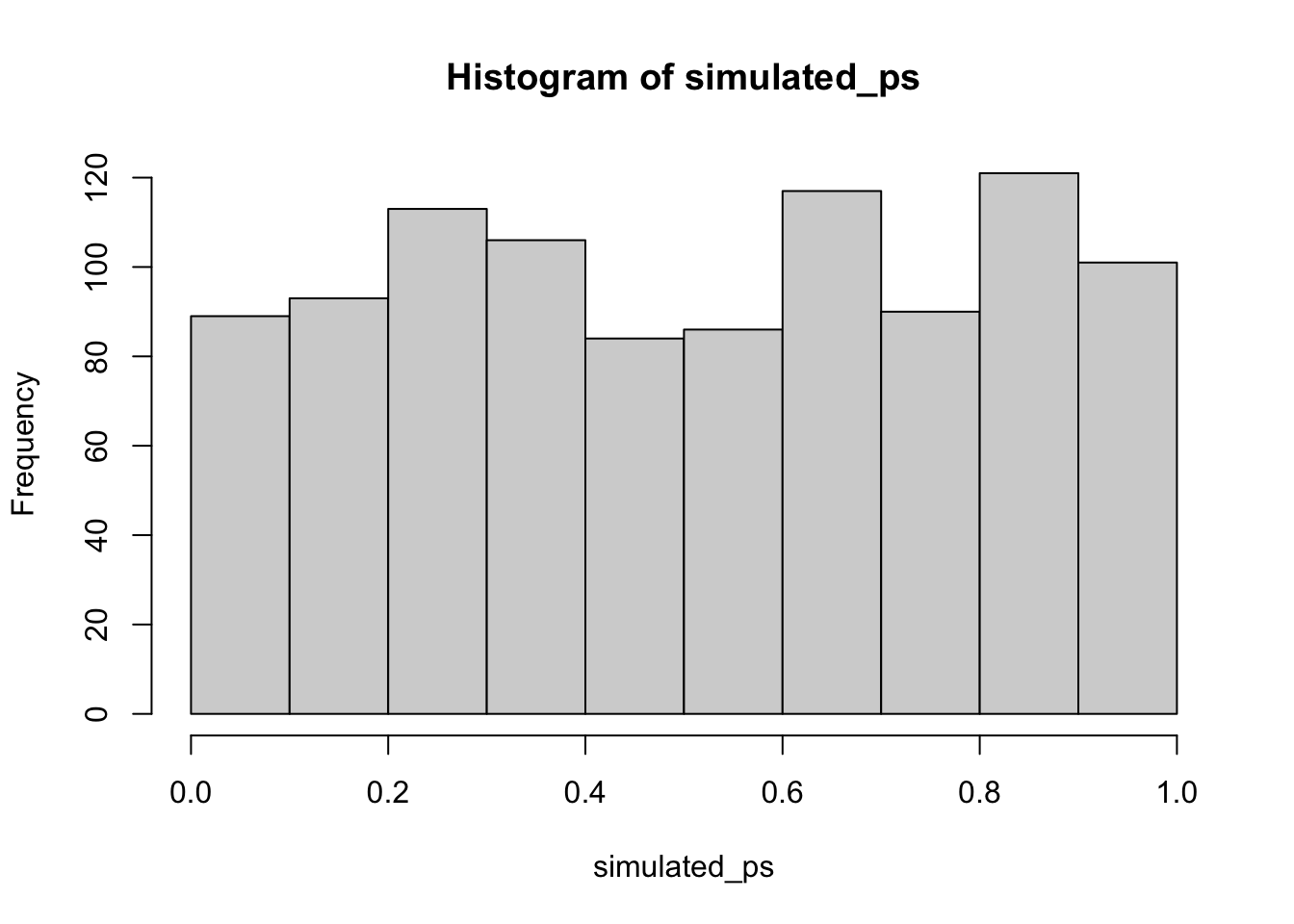
simulated_ps <- replicate(1000,
                          t.test(rnorm(30, 50, 25), mu = 50)$p.value)
hist(simulated_ps)
Subsection 6.5.2 Simulating a paired samples t-test
The process is set up to sample 10 scores for condition A and B from the same normal distribution. The simulation is conducted 1000 times, and the \(t\)s and \(p\)s are saved and plotted for each.
Remark 6.5.10. R Code.
save_ps <- length(1000)
save_ts <- length(1000)
for ( i in 1:1000 ){
  condition_A <- rnorm(10,10,5)
  condition_B <- rnorm(10,10,5)
  differences <- condition_A - condition_B
  t_test <- t.test(differences, mu=0)
  save_ps[i] <- t_test$p.value
  save_ts[i] <- t_test$statistic
}
Remark 6.5.11. R Code.
hist(save_ts)
Remark 6.5.13. R Code.
hist(save_ps)
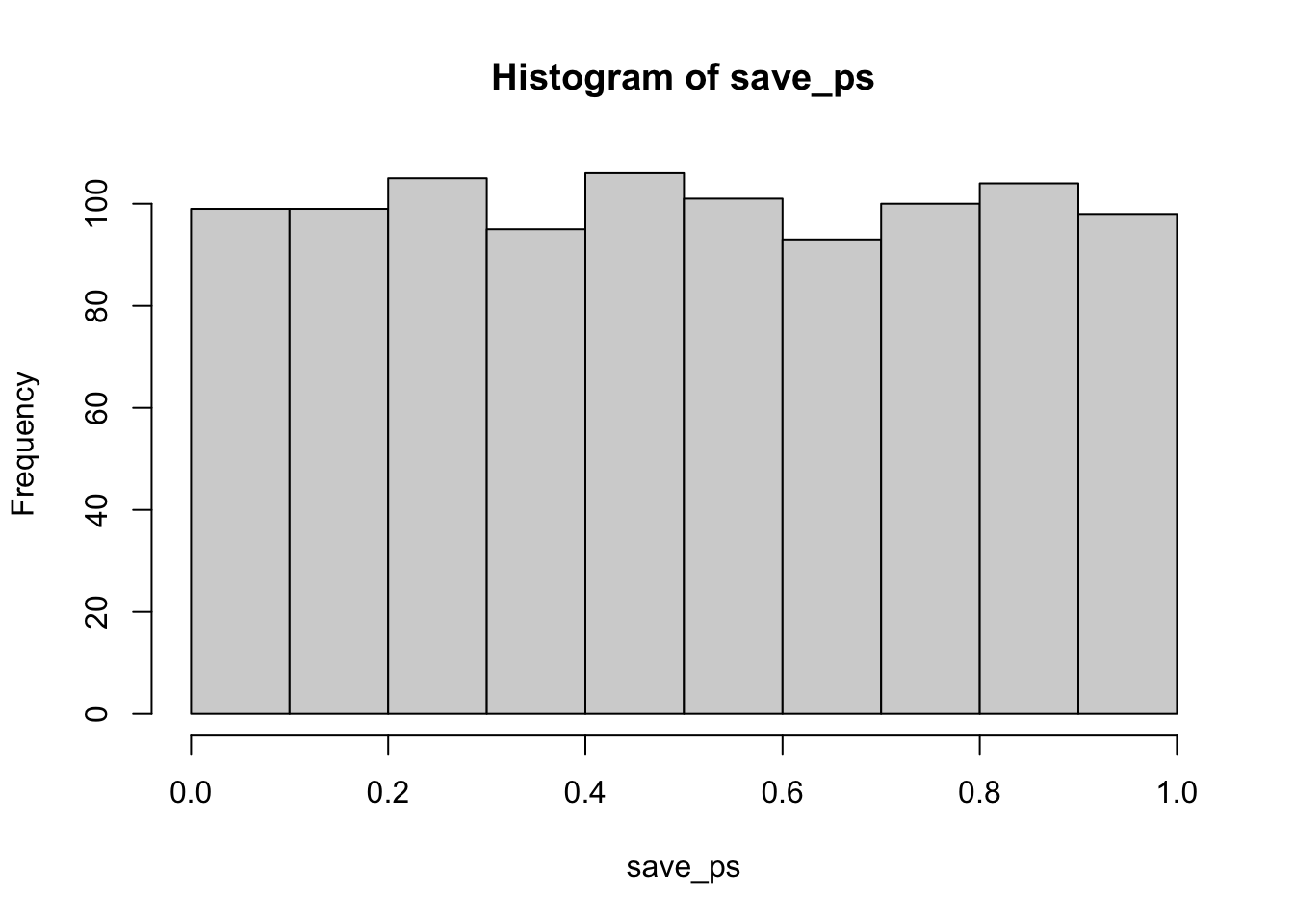
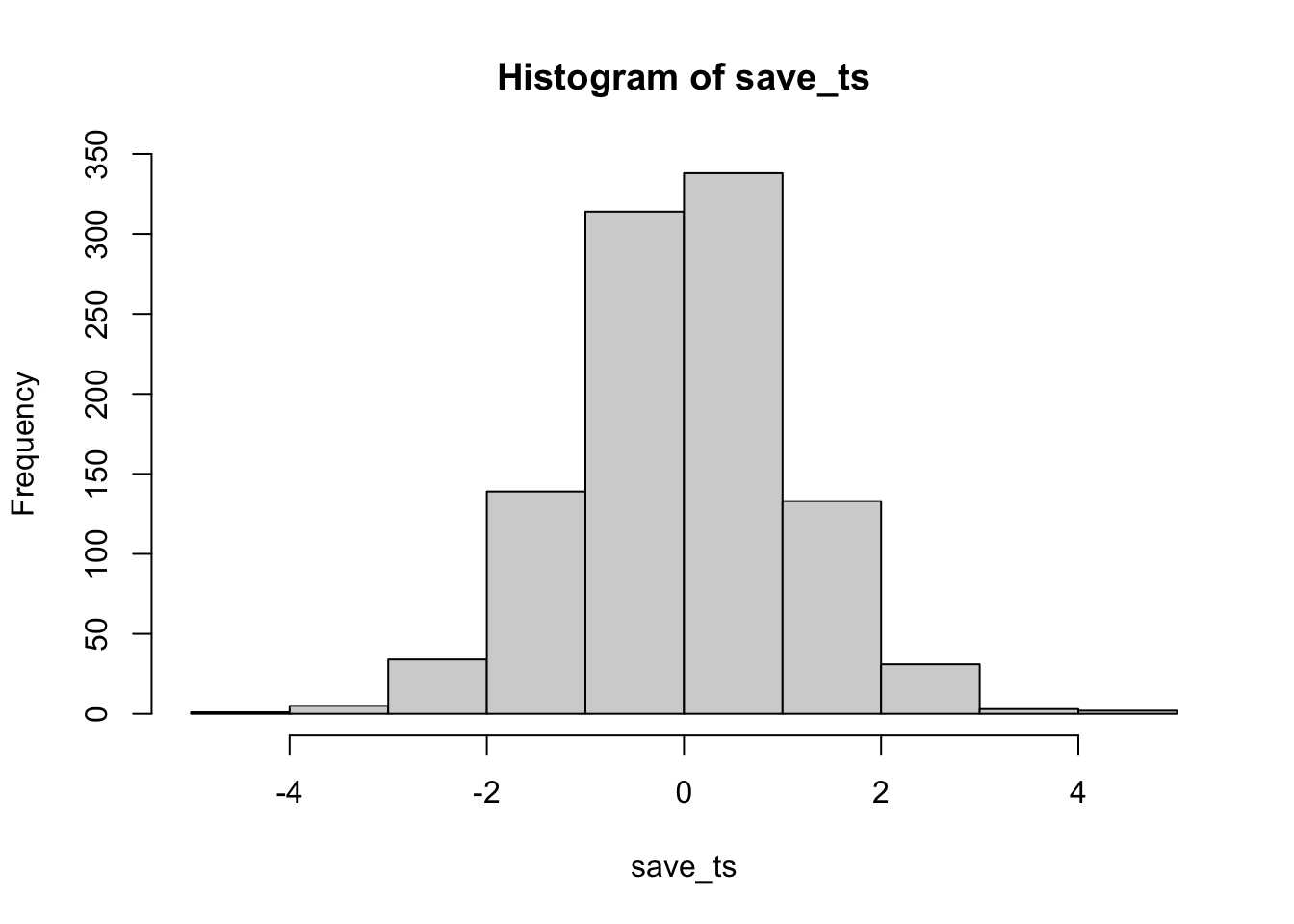
According to the simulation. When there are no differences between the conditions, and the samples are being pulled from the very same distribution, you get these two distributions for \(t\) and \(p\text{.}\) These again show how the null distribution of no differences behaves.
For any of these simulations, if you rejected the null-hypothesis (that your difference was only due to chance), you would be making a type I error. If you set your alpha criteria to \(\alpha = 0.05\text{,}\) we can ask how many type I errors were made in these 1000 simulations. The expectation over the long run is 5% type I error rates (if your alpha is 0.05).
Remark 6.5.15. R Code.
length(save_ps[save_ps<.05])
length(save_ps[save_ps<.05])/1000
#> [1] 49
#> [1] 0.049
What happens if there actually is a difference in the simulated data, let’s set one condition to have a larger mean than the other:
Remark 6.5.16. R Code.
save_ps <- length(1000)
save_ts <- length(1000)
for ( i in 1:1000 ){
  condition_A <- rnorm(10,10,5)
  condition_B <- rnorm(10,13,5)
  differences <- condition_A - condition_B
  t_test <- t.test(differences, mu=0)
  save_ps[i] <- t_test$p.value
  save_ts[i] <- t_test$statistic
}
#> [1] 225
#> [1] 0.225
Remark 6.5.17. R Code.
hist(save_ts)
Remark 6.5.19. R Code.
hist(save_ps)
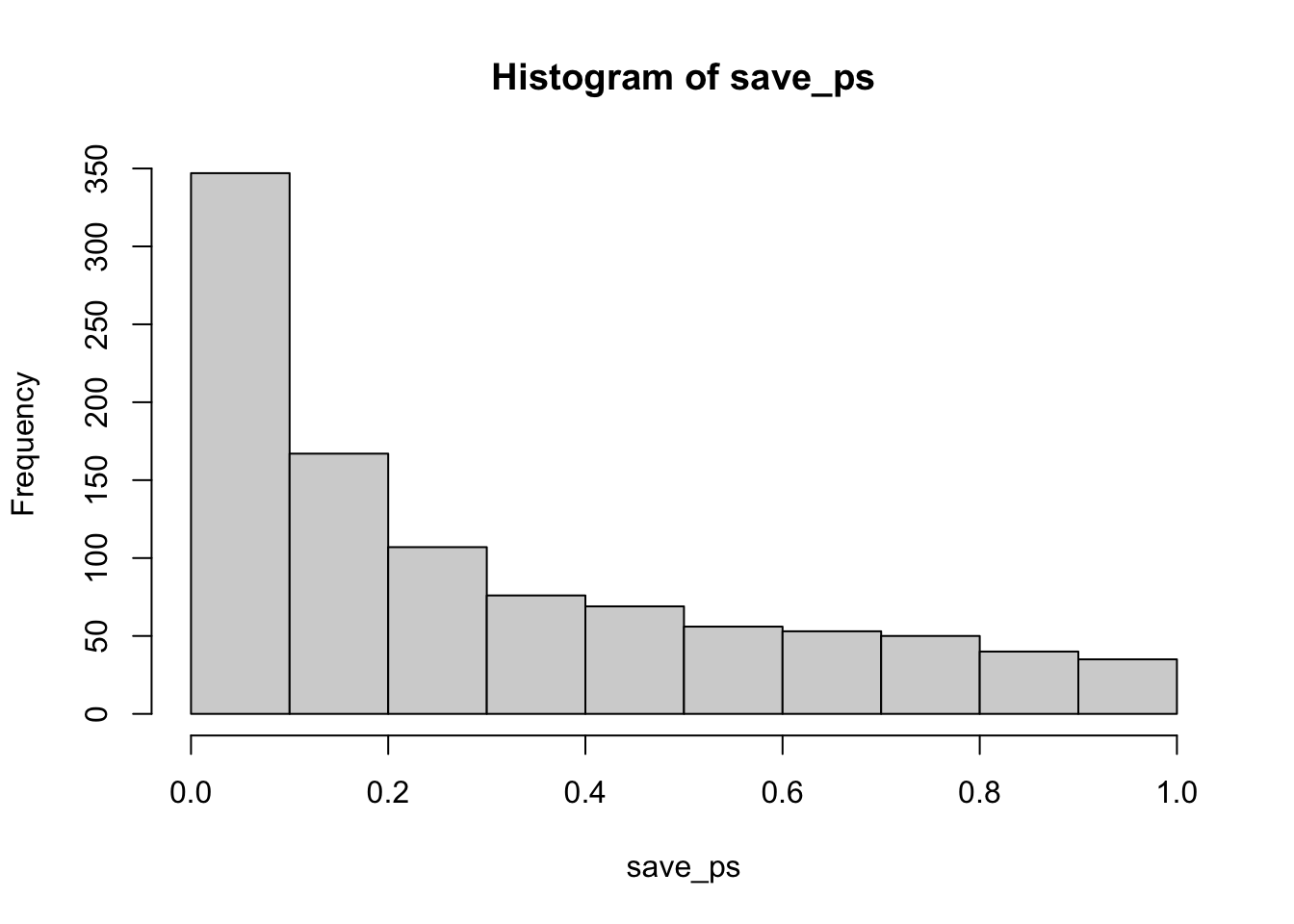
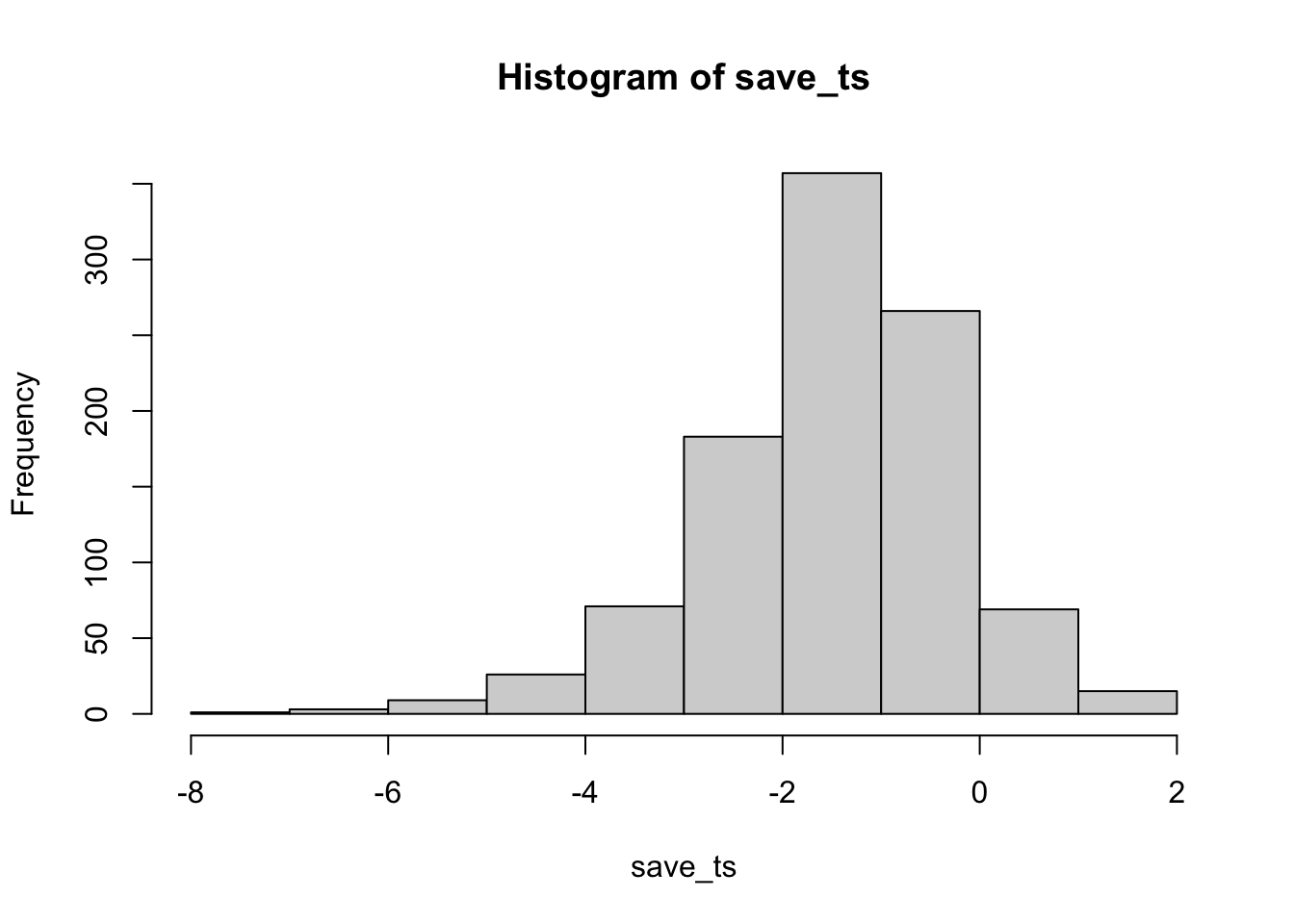
Now you can see that the \(p\)-value distribution is skewed to the left. This is because when there is a true effect, you will get p-values that are less than 0.05 more often. Or, rather, you get larger \(t\) values than you normally would if there were no differences.
In this case, we wouldn’t be making a type I error if we rejected the null when p was smaller than 0.05. If you were the researcher, would you want to run an experiment that would be successful only some of the time? I wouldn’t. I would run a better experiment.
Remark 6.5.21. R Code.
length(save_ps[save_ps<.05])
length(save_ps[save_ps<.05])/1000
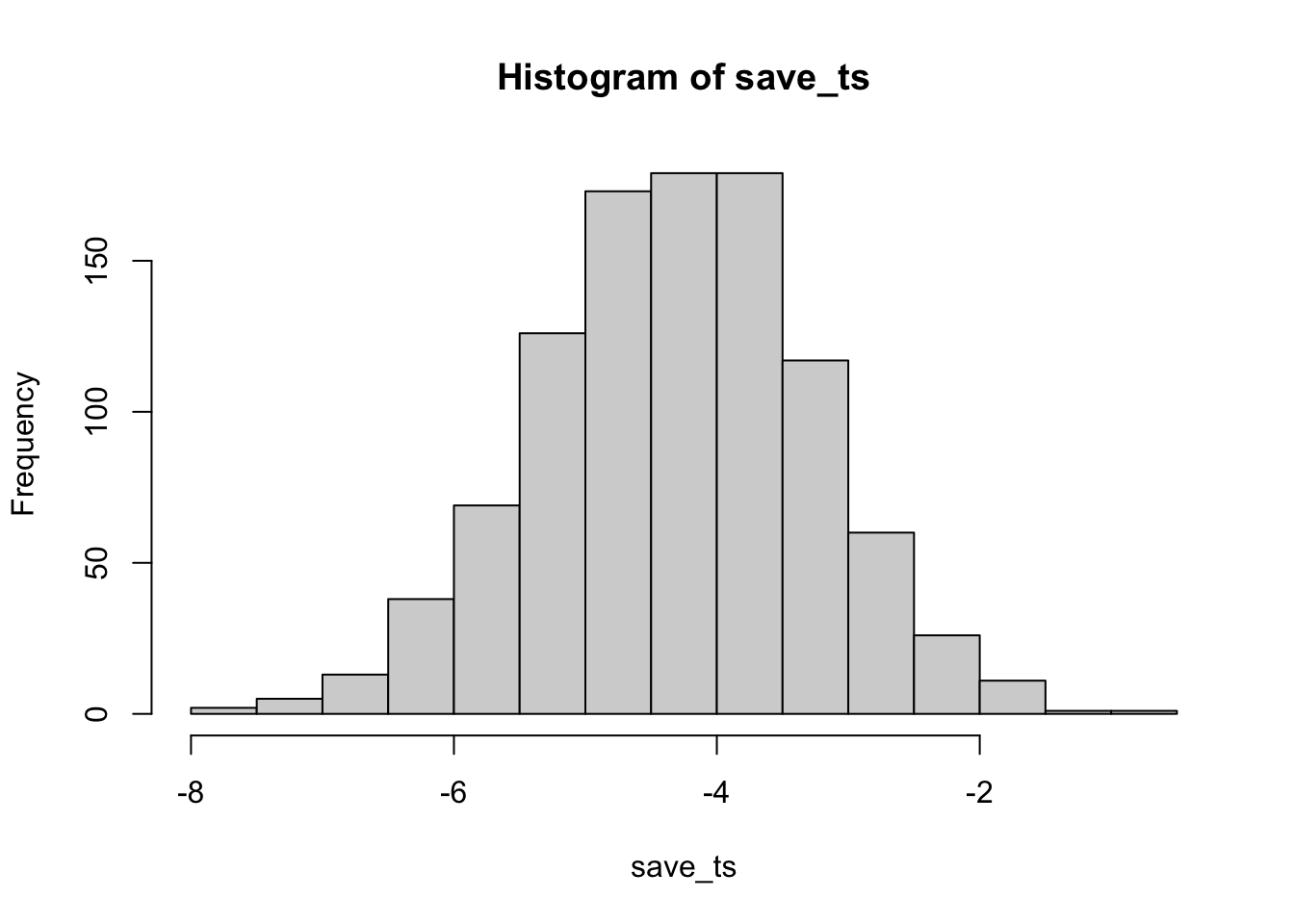
How would you run a better simulated experiment? Well, you could increase \(n\text{,}\) the number of subjects in the experiment. Let’s increase \(n\) from 10 to 100, and see what happens to the number of “significant” simulated experiments.
Remark 6.5.22. R Code.
save_ps <- length(1000)
save_ts <- length(1000)
for ( i in 1:1000 ){
  condition_A <- rnorm(100,10,5)
  condition_B <- rnorm(100,13,5)
  differences <- condition_A - condition_B
  t_test <- t.test(differences, mu=0)
  save_ps[i] <- t_test$p.value
  save_ts[i] <- t_test$statistic
}
Remark 6.5.23. R Code.
hist(save_ts)
Remark 6.5.25. R Code.
hist(save_ps)

length(save_ps[save_ps<.05])
length(save_ps[save_ps<.05])/1000
#> [1] 988
#> [1] 0.988
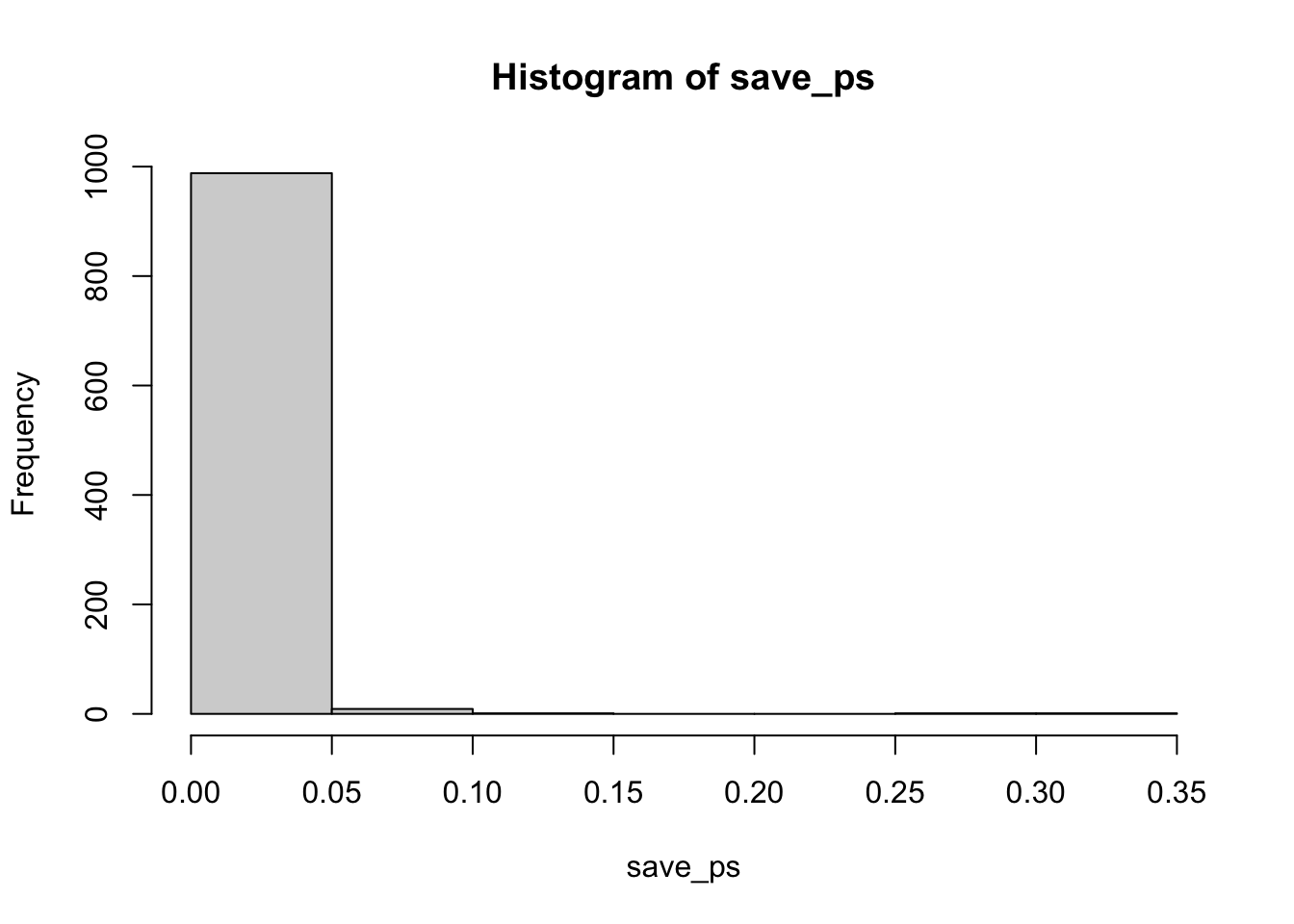
Cool, now almost all of the experiments show a \(p\)-value of less than 0.05 (using a two-tailed test, that’s the default in R). See, you could use this simulation process to determine how many subjects you need to reliably find your effect.
Subsection 6.5.3 Simulating an independent samples t.test
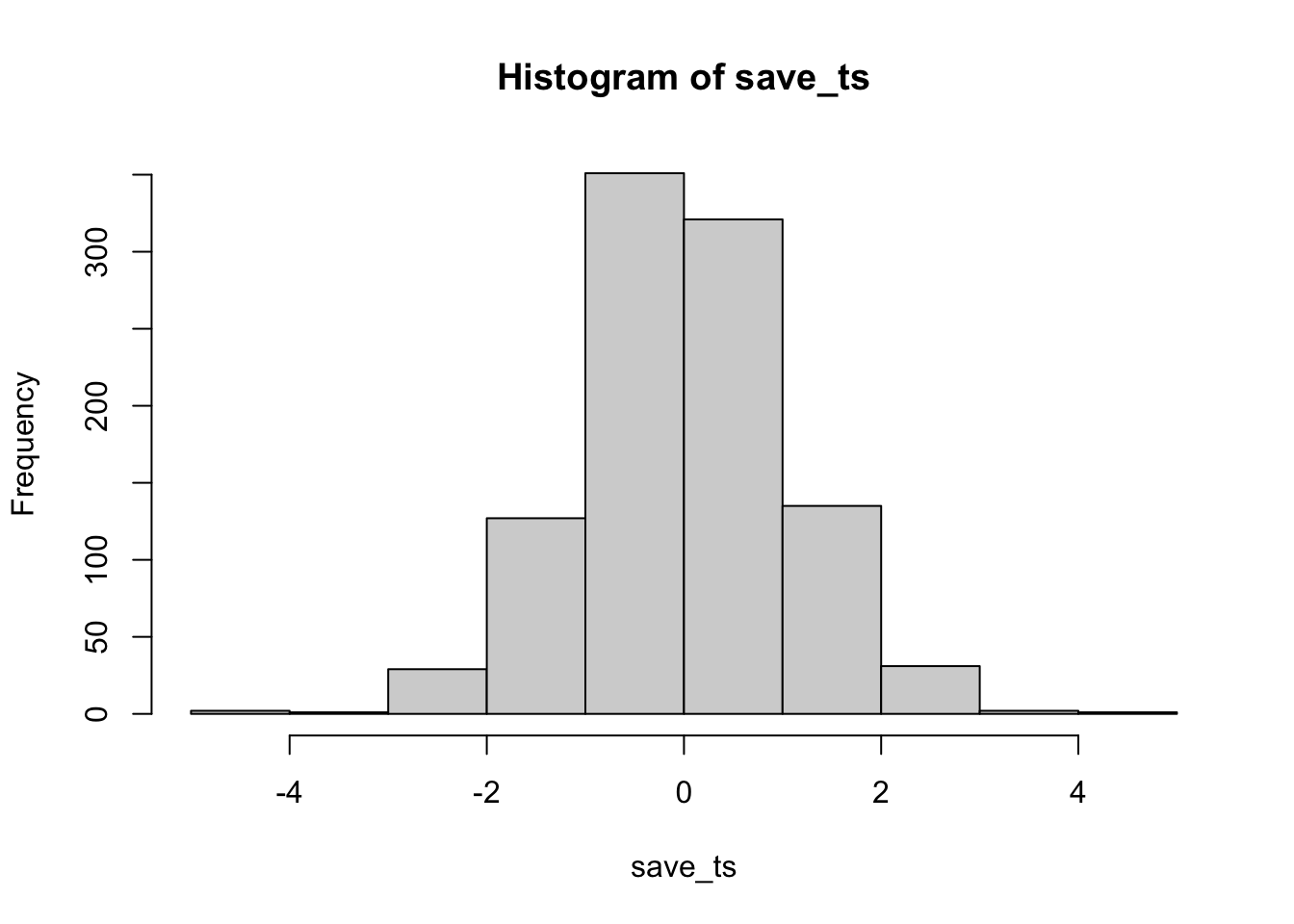
For the independent samples t-test simulation, we use a similar approach but with separate groups. This is for the null, assuming no difference between groups.
Remark 6.5.27. R Code.
save_ps <- length(1000)
save_ts <- length(1000)
for ( i in 1:1000 ){
  group_A <- rnorm(10,10,5)
  group_B <- rnorm(10,10,5)
  t_test <- t.test(group_A, group_B, paired=FALSE, var.equal=TRUE)
  save_ps[i] <- t_test$p.value
  save_ts[i] <- t_test$statistic
}
Remark 6.5.28. R Code.
hist(save_ts)
Remark 6.5.30. R Code.
hist(save_ps)

length(save_ps[save_ps<.05])
length(save_ps[save_ps<.05])/1000
#> [1] 48
#> [1] 0.048
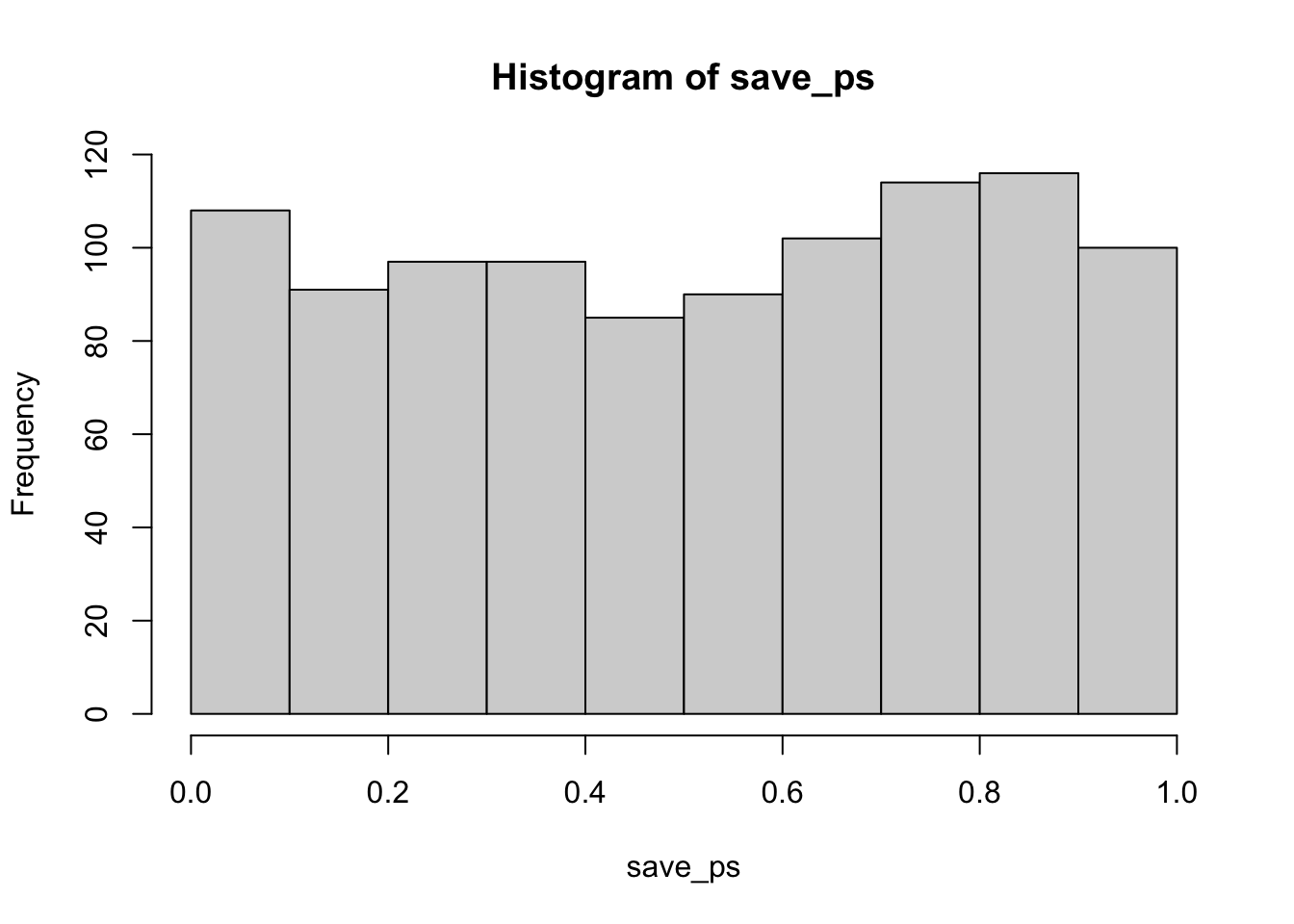
The distributions show the expected behavior under the null hypothesis for independent samples.

