Standardized tests like the SAT are often used as part of the admission process at colleges and universities. The goal of the SAT is to measure the academic preparation of the test-takers; if it is accurate, their scores should reflect their actual ability in the domain of the test.
Until recently, tests like the SAT were taken with paper and pencil, but now students have the option of taking the test online. In the online format, it is possible for the test to be "adaptive", which means that it can choose each question based on responses to previous questions.
If a student gets the first few questions right, the test can challenge them with harder questions. If they are struggling, it can give them easier questions. Adaptive testing has the potential to be more "efficient", meaning that with the same number of questions an adaptive test could measure the ability of a tester more precisely.
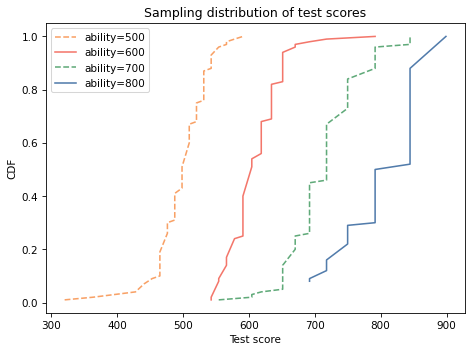
To see whether this is true, we will develop a model of an adaptive test and quantify the precision of its measurements.
Details of this exercise are in the notebook.
def prob_correct(ability, difficulty):
    """Probability of a correct response."""
    a = 100
    c = 0.25
    x = (ability - difficulty) / a
    p = c + (1-c) / (1 + np.exp(-x))
    return p
I chose
a to make the range of scores comparable to the SAT, which reports scores from 200 to 800.
Here’s what the logistic curve looks like for a question with difficulty 500 and a range of abilities.
abilities = np.linspace(100, 900)
diff = 500
ps = prob_correct(abilities, diff)
plt.plot(abilities, ps)
decorate(xlabel='Ability',
         ylabel='Probability correct',
         title='Probability of correct answer, difficulty=500',
         ylim=[0, 1.05])
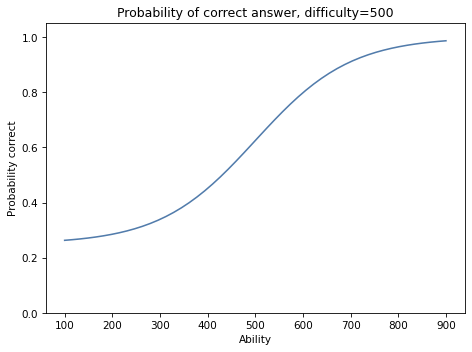
Someone with
ability=900 is nearly certain to get the right answer. Someone with ability=100 has about a 25% chance of getting the right answer by guessing.