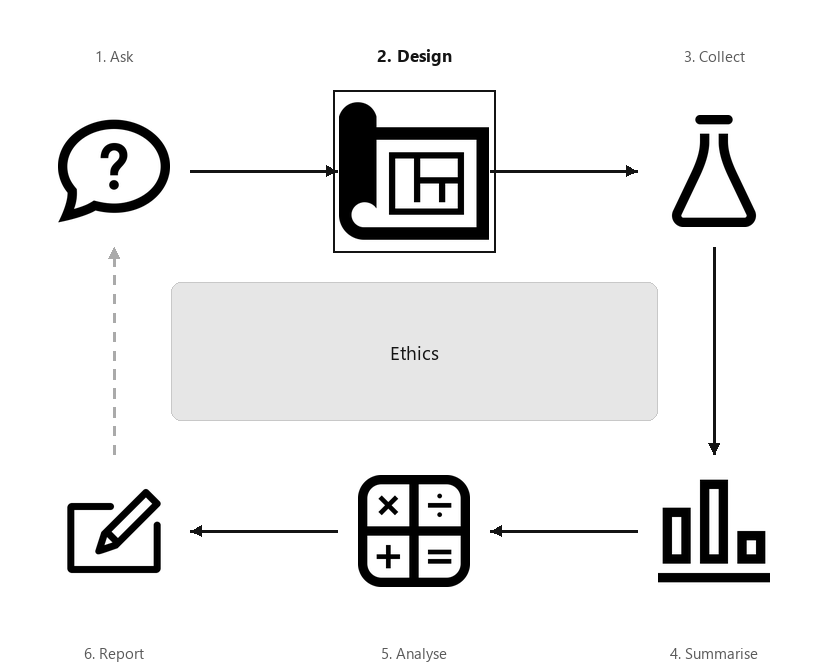
A diagram showing the six steps of research, arranged in a cycle: Ask, Design, Collect, Classify and summarise, Analyse, Report. Step 2 (Design) is highlighted, captioned “Ethics”.
All research must be ethical, and must meet ethical guidelines, to minimise risk of harm to the environment, property and to participants, and to preserve the well-being, dignity, rights and safety of participants (including animals). Practically every university and research organisation in the world promotes and enforces ethical research practices.
Most research studies require an ethics committee to formally grant ethics approval before research begins. Only brief comments about research ethics are given here.
Acknowledgements: all those who contributed to the research should be acknowledged, including those who prepare figures, take photographs, or have helped collect data.
Consent: when appropriate, people should consent to being in the study, and hence should be told what the study involves. People should also be able to withdraw from the study without penalty.
Funding: sources of funding should be disclosed. Any studies funded by, or sanctioned by, companies or organisations with vested interests need to be carefully scrutinised. These may lead to, or may give the impression of, conflicts of interest.
Incentives to participate: if participants are offered incentives to participate (above reimbursement of costs), these should be acknowledged as it may cause (perhaps unconsciously), or may give the impression of causing, participants to influence the results.
In the Tuskegee syphilis experiment, conducted between 1932 and 1972, treatments were actively withheld from men with syphilis [12]. The men’s wives and children were often affected, and the men were lied to about their treatments. This study was highly unethical, and could not be conducted now.
In 1986, the American space shuttle Challenger exploded just after launch, killing all seven astronauts on board. A review [32] found the cause was partly that engineers failed to use some data that should have been used. This was unethical.
One way to ensure that research results are reliable and trustworthy is through reproducible research: enabling someone else to repeat the study and analysis, to confirm the findings. For research to be reproducible, the methods, data, analysis methods and relevant computer code must be available [56] when possible. (Sometimes releasing data is unethical, such as when individuals may be identified, so should not be released.)
Methods for ensuring reproducible research are often discipline dependent, and beyond the scope of this book. Different journals also have different expectations regarding reproducibility. Nonetheless, the basic ideas are important.
There are serious medical consequences to errors attributable to the effects of spreadsheet programs and software operated through a graphical user interface […] that could have been avoided through a reproducible research paradigm…
Rather than using spreadsheets (see Section 2.12), using tools which encourage reproducible research are recommended. Statistical software packages, such as jamovi, Python, R, SAS, SPSS and Stata, are recommended as the analysis commands can be recorded (even when using the point-and-click interfaces), and hence the analysis is reproducible.
The population contains marked individuals for which the research team has incredibly detailed data […] this research has lead to numerous important publications.
Recently, however, a cougar (Puma concolor) that has learned to specialize on these sheep is slowly but surely eating all of them. This is a study of a natural population, which includes predation, but this cougar is drastically reducing the sample size of the study.
Since it is legal to hunt cougars in the region where this study is taking place, one option is to try to kill the predator; however, even if a cougar were successfully hunted, this would not ensure that it was the correct one.
Suppose a research group is testing a new drug, with the potential to cure a debilitating illness. The researchers could (a) use a control group that does not receive the new drug, and so obtain stronger evidence for using the drug if it works; or (b) not use a control group, so that everyone in the study potentially benefits from the using the new drug.
Suppose a very deadly and highly contagious disease breaks out. Is it ethical to use a new drug to treat those affected, even though the drug is experimental and the potentially harmful side effects are unknown? Discuss your point-of-view.
Is it ethical to lie to subjects? Deception is used in some disciplines, and may be approved by ethics committees under some circumstances (such as potential benefits of the study, and whether the deception may cause physical or psychological discomfort to the participants).
Is it ethical to tell participants that they are taking an active medication, when it is actually ineffective (a “placebo”)? Discuss the advantages and disadvantages.