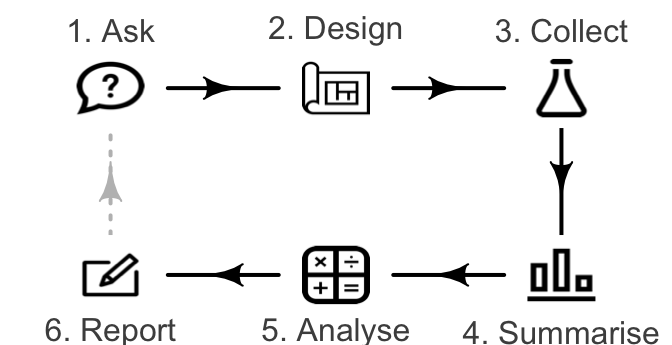
The research process (for both qualitative and quantitative research) ideally follows the process summarised in Figure 1.4.1, but this is not always possible or practical. The process is not always linear: researchers may jump from step to step as necessary, and research often leads to new research questions (RQs) so that the process restarts. Each step is important.
A diagram showing the six basic steps in the quantitative research process, arranged in a cycle: Ask, Design, Collect, Classify and summarise, Analyse, Report.
Designing the study (Chapter 3 to Chapter 8). Evidence-based research uses data to answer the RQ. A study is designed to obtain that data: determining who or what to study; finding those to study; deciding what information to obtain; and ensuring data are obtained ethically.
Classifying and summarising the data (Chapter 10 to Chapter 17). Before analysis, the data must be classified and summarised to inform the analysis. (A computer is useful.)
Reporting the results (Chapter 35 and Chapter 36). Communicating the results appropriately, accurately and ethically is important, including identifying any limitations of the research.