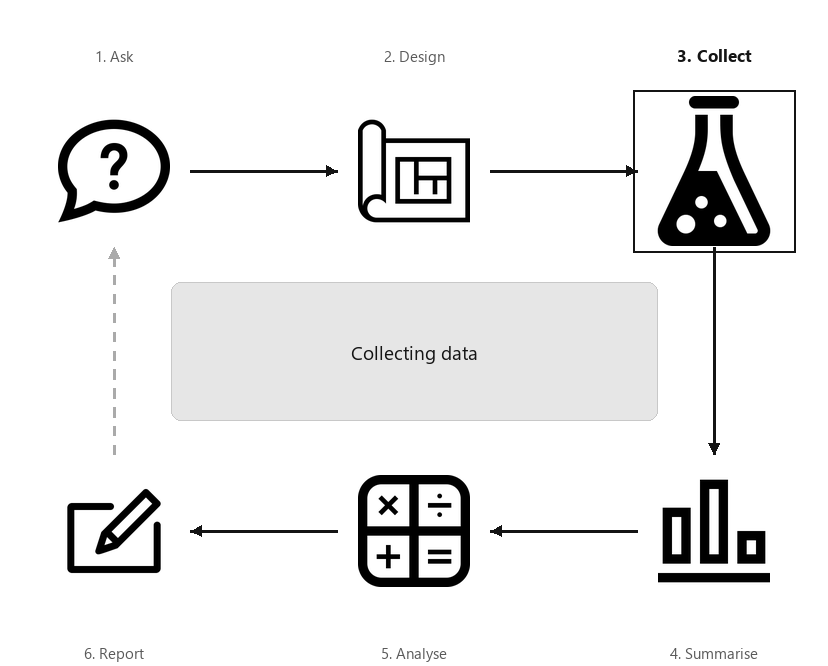
A diagram showing the six steps of research, arranged in a cycle: Ask, Design, Collect, Classify and summarise, Analyse, Report. Step 3 (Collect) is highlighted, captioned “Collecting data”.
If the RQ is well-constructed, terms are clearly defined, and the study is well-designed and explained, then the process for collecting the data should be easy to describe. Data collection is often time-consuming, tedious and expensive, so collecting the data correctly first time is important, hence an accurate description of the data collection process is essential.
Data collection is often tedious, time-consuming and expensive: you usually get one chance to collect data. In contrast, data (once collected) can be analysed as many times as necessary. Design the study properly the first time!
Before collecting the data, a plan should be established and documented that explains exactly how the data will be obtained, which will include operational definitions (Section 2.10). This plan is called a protocol, and allows results to be confirmed and compared.
[230] made cookies using puréed green peas in place of margarine (to increase the nutritional value of cookies). They assessed the acceptance of these cookies to college students.
This voluntary sample comprised \(80.6\)% women, a higher percentage than in the general population, and in the college population. (Other extraneous variables were also recorded.)
Exclusion criteria were also applied, excluding people ’with an allergy or sensitivity to an ingredient used in the preparation of the cookies’ (p. 5). The researchers also described how the data were obtained, including these steps (p. 5):
Thus, internal validity was addressed using random allocation (to manage confounding), blinding individuals (to partially manage the Hawthorne effect), and washouts (to manage the carryover effect). Details are also given of how the cookies were made, and how objective measurements (such as moisture content) were determined. Subjects were not blinded to being in a study, but were blinded to which substitution percentage was in each cookie.
In a study where the sex of a person is the explanatory variable, an operational definition for the sex of the person is needed. That is, a description is needed for how the researchers determine the sex of the person.
One option is to ask each individual their sex. Another option is to make an informed assessment, based on clothing and body shape, for instance. A third option is to have subjects indicate their sex in a multiple-choice question.
Different types of studies may require different means for determining the sex of a person. The study protocol should explain how the sex of the person will be established.
A pilot study is a small test run of the study used to check that the protocol is appropriate and practical, and to identify (and hence fix) possible problems with the research design or protocol.
The data can be collected once the protocol has been finalised. Protocols ensure studies are reproducible (Section 5.3), so others can confirm or compare results, and others can understand exactly what was done, and how. Protocols should indicate how design aspects (such as blinding the individuals, random allocation of treatments, etc.) will happen. The final protocol, without pedantic detail, should be reported. Diagrams can be useful to support explanations. All studies should have a well-established protocol for describing how the study was done.
Fresh cow dung was obtained from free-ranging, grass fed, and antibiotic-free Milking Shorthorn cows (Bos taurus) in the Tilden Regional Park in Berkeley, CA. Resting cows were approached with caution and startled by loud shouting, whereupon the cows rapidly stood up, defecated, and moved away from the source of the annoyance. Dung was collected in ZipLoc bags (\(1\) gallon), snap-frozen and stored at \(-80\) C.
Collecting data using questionnaires is common for both observational and experimental studies. Questionnaires are very difficult to do well: question wording is crucial, and surprisingly difficult [255]. Pilot testing questionnaires is crucial.
A questionnaire is a set of questions to obtain information from individuals. A survey is an entire methodology, that includes gathering data using a questionnaire, finding a sample, and other components.
Questions in a questionnaire may be open-ended (respondents can write their own answers) or closed (respondents select from a small number of possible answers, as in multiple-choice questions). Open-ended and closed questions both have advantages and disadvantages. Answers to open-ended questions more easily lend themselves to qualitative analysis and closed questions more to quantitative research. This section briefly discusses writing questions.
In which ecosystems are microplastics in Germany? Tick the answer (multiple ticks are possible). Options: (a) sea; (b) rivers; (c) lakes; (d) groundwater.
The first question is open-ended: respondents provide their own answers. The second question is closed, where multiple options can be selected. The third question is closed, where only one option can be selected.
avoiding asking the uninformed; avoid asking respondents about issues they don’t know about. Many people will give a response even if they do not understand (and such responses are worthless). For example, people may give directions to places that do not even exist [200].
avoiding problems with ethics, such as questions about people breaking laws, or revealing confidential or private information. In special cases and with justification, ethics committees may allow such questions.
Because bottles from bottled water create enormous amounts of non-biodegradable landfill and hence threaten native wildlife, do you support banning bottled water?
Question 3 is unlikely to give sensible answers, as most people will be uninformed. Many people will still give an opinion, but the data will be effectively useless (though the researcher may not realise).
Question wording can be important. In the 2014 General Social Survey (https://gss.norc.org), when white Americans were asked for their opinion of the amount America spends on welfare, \(58\)% of respondents answered ’Too much’. However, when white Americans were asked for their opinion of the amount America spends on assistance to the poor, only \(16\)% of respondents answered ’Too much’ [296].
Non-response bias (Section 6.7): non-response bias is common with questionnaires, as they are often used with voluntary-response samples (Subsection 6.4.2). The people who do not respond to the survey may be different from those who do respond.
Response bias (Section 6.7): people do not always answer truthfully; for example, what people say may not correspond with what people do (Example 8.11). Sometimes this is unintentional (e.g., poor questions wording), due to embarrassment, or because questions are controversial. Sometimes, respondents repeatedly provide the same answer (without reading the question) to a series of multiple-choice questions (i.e., always select ’Always’).
[181] studied the knowledge, attitude, and level of confidence of paramedics when managing patients with visual or hearing problems. They used a questionnaire, which was sent to (p. 5)
... \(372\) potential participants with the expectation that at least \(310\) questionnaires [would] be returned (\(83\)% assumed return rate). However, only \(97\) out of \(372\) participants completed the questionnaire, resulting in actual return rate of \(26\)%.
Subsection9.3.3Preparing software for questionnaire data
Care is needed when preparing software for data collected using a questionnaire. Sometimes, of course, the data are collected by computer (e.g., online) and are supplied to the researchers already formatted and in electronic format.
Data from open questions are usually text-based (such as words, sentences or paragraphs of text). These can generally be included in the data worksheet (though there may be a limit to the length of such data), but cannot be analysed using the quantitative methods described in this book.
Closed questions are easily included in a data worksheet. In closed questions where respondents can select one option only, one column is needed for the question that records which option was selected. In closed questions where respondents can select all options that apply, each option requires its own column that records each respondents’ answer for that option.
In Example 9.9, three questionnaire questions are given that were asked of German students about microplastics [104]. Some (artificial) data are shown entered in Figure 9.15.
The first question requires open-ended, text-based answers (Sources). For the second (closed) question, students could select multiple options, so each option needs one column in the data worksheet (WhereSeas to WhereGroundwater). The third (closed) question required students to select one option from a given list, so one column (Danger) is needed to record responses. As usual (Section 2.12), each row represents one unit of analysis (student).
Screenshot of a data worksheet showing columns for Sources (open-ended text), WhereSeas through WhereGroundwater (binary closed options), and Danger (single-select closed option), with one row per student.
Having a detailed procedure for collecting the data (the protocol) is important. Using a pilot study to trial the protocol can reveal unexpected changes necessary for a good protocol. Creating good questionnaires questions is difficult, but important.
how long do you usually stay in the sun between \(11\)am and \(3\)pm, during a typical day-off in the summer (June–August)? (Possible answers: \(< 30\text{,}\)\(30\)–\(1\text{,}\)\(1\)–\(2\text{,}\)\(2\)–\(3\text{,}\)\(>3\)).