Look back to the study in SectionΒ 1.1 where researchers were testing whether stents were effective at reducing strokes in at-risk patients. Is this an experiment? Was the study blinded? Was it double-blinded?
Section 1.4 Experiments
Studies where the researchers assign treatments to cases are called experiments. When this assignment includes randomization, e.g. using a coin flip to decide which treatment a patient receives, it is called a randomized experiment. Randomized experiments are fundamentally important when trying to show a causal connection between two variables.
Subsection 1.4.1 Principles of experimental design
Randomized experiments are generally built on four principles.
- Controlling.
-
Researchers assign treatments to cases, and they do their best to control any other differences in the groups.For example, when patients take a drug in pill form, some patients take the pill with only a sip of water while others may have it with an entire glass of water. To control for the effect of water consumption, a doctor may ask all patients to drink a 12 ounce glass of water with the pill.
β1β
This is a different concept than a control group, which we discuss in the second principle and in SubsectionΒ 1.4.2. - Randomization.
-
Researchers randomize patients into treatment groups to account for variables that cannot be controlled. For example, some patients may be more susceptible to a disease than others due to their dietary habits. Randomizing patients into the treatment or control group helps even out such differences, and it also prevents accidental bias from entering the study.
- Replication.
-
The more cases researchers observe, the more accurately they can estimate the effect of the explanatory variable on the response. In a single study, we replicate by collecting a sufficiently large sample. Additionally, a group of scientists may replicate an entire study to verify an earlier finding.
- Blocking.
-
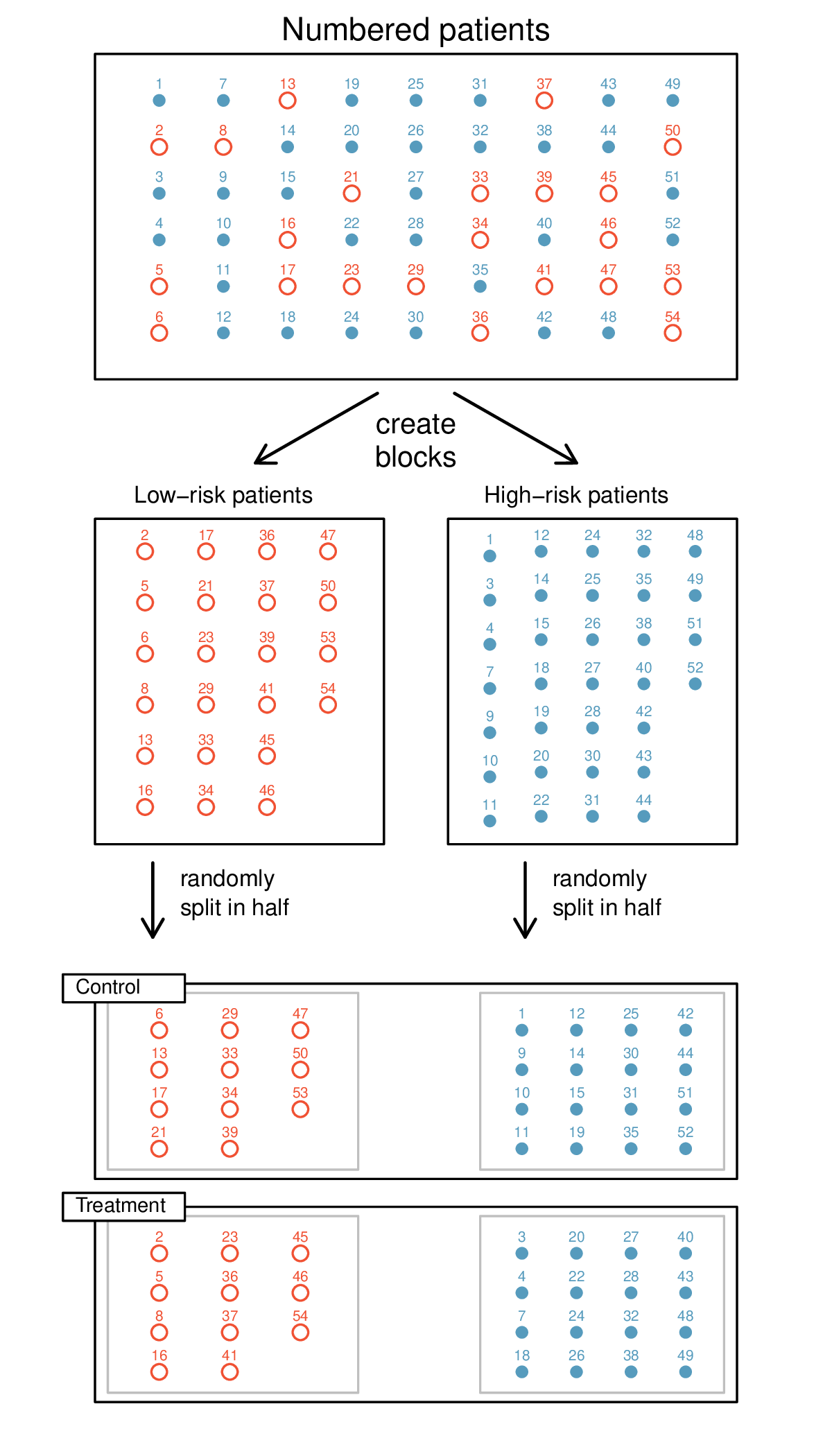
Researchers sometimes know or suspect that variables, other than the treatment, influence the response. Under these circumstances, they may first group individuals based on this variable into blocks and then randomize cases within each block to the treatment groups. This strategy is often referred to as blocking. For instance, if we are looking at the effect of a drug on heart attacks, we might first split patients in the study into low-risk and high-risk blocks, then randomly assign half the patients from each block to the control group and the other half to the treatment group, as shown in FigureΒ 1.4.1. This strategy ensures each treatment group has an equal number of low-risk and high-risk patients.

It is important to incorporate the first three experimental design principles into any study, and this book describes applicable methods for analyzing data from such experiments. Blocking is a slightly more advanced technique, and statistical methods in this book may be extended to analyze data collected using blocking.
Subsection 1.4.2 Reducing bias in human experiments
Randomized experiments are the gold standard for data collection, but they do not ensure an unbiased perspective into the cause and effect relationship in all cases. Human studies are perfect examples where bias can unintentionally arise. Here we reconsider a study where a new drug was used to treat heart attack patients. In particular, researchers wanted to know if the drug reduced deaths in patients.
These researchers designed a randomized experiment because they wanted to draw causal conclusions about the drugβs effect. Study volunteers were randomly placed into two study groups. One group, the treatment group, received the drug. The other group, called the control group, did not receive any drug treatment.
β2β
Human subjects are often called patients, volunteers, or study participants.
Put yourself in the place of a person in the study. If you are in the treatment group, you are given a fancy new drug that you anticipate will help you. On the other hand, a person in the other group doesnβt receive the drug and sits idly, hoping her participation doesnβt increase her risk of death. These perspectives suggest there are actually two effects: the one of interest is the effectiveness of the drug, and the second is an emotional effect that is difficult to quantify.
Researchers arenβt usually interested in the emotional effect, which might bias the study. To circumvent this problem, researchers do not want patients to know which group they are in. When researchers keep the patients uninformed about their treatment, the study is said to be blind. But there is one problem: if a patient doesnβt receive a treatment, she will know she is in the control group. The solution to this problem is to give fake treatments to patients in the control group. A fake treatment is called a placebo, and an effective placebo is the key to making a study truly blind. A classic example of a placebo is a sugar pill that is made to look like the actual treatment pill. Often times, a placebo results in a slight but real improvement in patients. This effect has been dubbed the placebo effect.
The patients are not the only ones who should be blinded: doctors and researchers can accidentally bias a study. When a doctor knows a patient has been given the real treatment, she might inadvertently give that patient more attention or care than a patient that she knows is on the placebo. To guard against this bias, which again has been found to have a measurable effect in some instances, most modern studies employ a double-blind setup where doctors or researchers who interact with patients are, just like the patients, unaware of who is or is not receiving the treatment.
β3β
There are always some researchers involved in the study who do know which patients are receiving which treatment. However, they do not interact with the studyβs patients and do not tell the blinded health care professionals who is receiving which treatment.
Checkpoint 1.4.2. Blinding in the stent study.
Checkpoint 1.4.3. Placebos via sham surgery.
For the study in SectionΒ 1.1, could the researchers have employed a placebo? If so, what would that placebo have looked like?
Solution.
Ultimately, can we make patients think they got treated from a surgery? In fact, we can, and some experiments use whatβs called a sham surgery. In a sham surgery, the patient does undergo surgery, but the patient does not receive the full treatment, though they will still get a placebo effect.
You may have many questions about the ethics of sham surgeries to create a placebo after reading the previous exercise. These questions may have even arisen in your mind in the general experiment context, where a possibly helpful treatment was withheld from individuals in the control group; the main difference is that a sham surgery tends to create additional risk, while withholding a treatment only maintains a personβs risk.
There are always multiple viewpoints of experiments and placebos, and rarely is it obvious which is ethically βcorrectβ. For instance, is it ethical to use a sham surgery when it creates a risk to the patient? However, if we donβt use sham surgeries, we may promote the use of a costly treatment that has no real effect; if this happens, money and other resources will be diverted away from other treatments that are known to be helpful. Ultimately, this is a difficult situation where we cannot perfectly protect both the patients who have volunteered for the study and the patients who may benefit (or not) from the treatment in the future.
Exercises 1.4.3 Exercises
1. Light and exam performance.
A study is designed to test the effect of light level on exam performance of students. The researcher believes that light levels might have different effects on males and females, so wants to make sure both are equally represented in each treatment. The treatments are fluorescent overhead lighting, yellow overhead lighting, no overhead lighting (only desk lamps).
-
What is the response variable?
-
What is the explanatory variable? What are its levels?
-
What is the blocking variable? What are its levels?
2. Vitamin supplements.
To assess the effectiveness of taking large doses of vitamin C in reducing the duration of the common cold, researchers recruited 400 healthy volunteers from staff and students at a university. A quarter of the patients were assigned a placebo, and the rest were evenly divided between 1g Vitamin C, 3g Vitamin C, or 3g Vitamin C plus additives to be taken at onset of a cold for the following two days. All tablets had identical appearance and packaging. The nurses who handed the prescribed pills to the patients knew which patient received which treatment, but the researchers assessing the patients when they were sick did not. No significant differences were observed in any measure of cold duration or severity between the four groups, and the placebo group had the shortest duration of symptoms.
β4β
Citation: Audera:2001
-
Was this an experiment or an observational study? Why?
-
What are the explanatory and response variables in this study?
-
Were the patients blinded to their treatment?
-
Was this study double-blind?
-
Participants are ultimately able to choose whether or not to use the pills prescribed to them. We might expect that not all of them will adhere and take their pills. Does this introduce a confounding variable to the study? Explain your reasoning.
3. Light, noise, and exam performance.
A study is designed to test the effect of light level and noise level on exam performance of students. The researcher believes that light and noise levels might have different effects on males and females, so wants to make sure both are equally represented in each treatment. The light treatments considered are fluorescent overhead lighting, yellow overhead lighting, no overhead lighting (only desk lamps). The noise treatments considered are no noise, construction noise, and human chatter noise.
-
What type of study is this?
-
How many factors are considered in this study? Identify them, and describe their levels.
-
What is the role of the sex variable in this study?
4. Music and learning.
You would like to conduct an experiment in class to see if students learn better if they study without any music, with music that has no lyrics (instrumental), or with music that has lyrics. Briefly outline a design for this study.
5. Soda preference.
You would like to conduct an experiment in class to see if your classmates prefer the taste of regular Coke or Diet Coke. Briefly outline a design for this study.
6. Exercise and mental health.
A researcher is interested in the effects of exercise on mental health and he proposes the following study: Use stratified random sampling to ensure representative proportions of 18-30, 31-40 and 41- 55 year olds from the population. Next, randomly assign half the subjects from each age group to exercise twice a week, and instruct the rest not to exercise. Conduct a mental health exam at the beginning and at the end of the study, and compare the results.
-
What type of study is this?
-
What are the treatment and control groups in this study?
-
Does this study make use of blocking? If so, what is the blocking variable?
-
Does this study make use of blinding?
-
Comment on whether or not the results of the study can be used to establish a causal relationship between exercise and mental health, and indicate whether or not the conclusions can be generalized to the population at large.
-
Suppose you are given the task of determining if this proposed study should get funding. Would you have any reservations about the study proposal?

