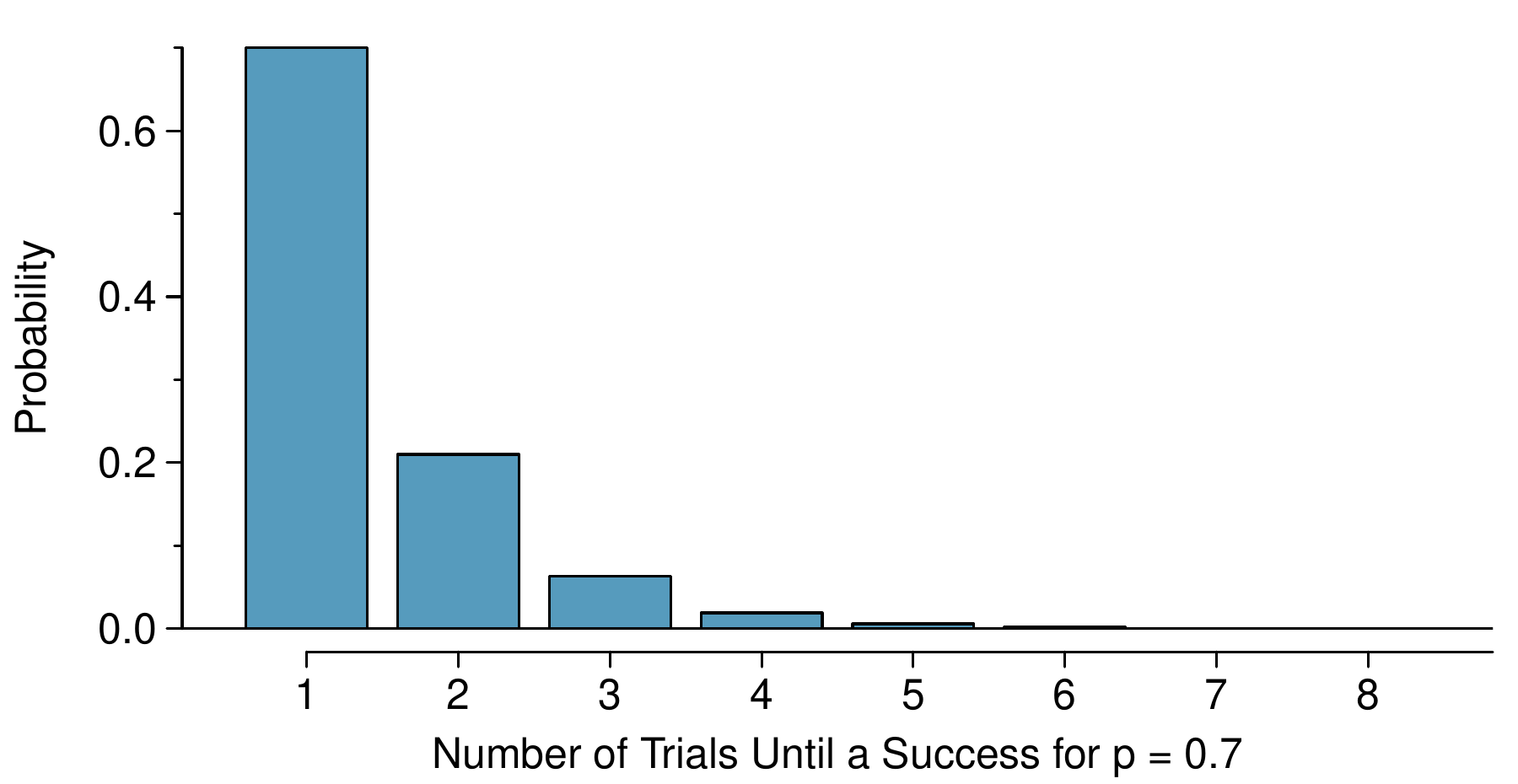
Suppose we are working at the insurance company and need to find a case where the person did not exceed her (or his) deductible as a case study. If the probability a person will not exceed her deductible is 0.7 and we are drawing people at random, what are the chances that the first person will not have exceeded her deductible, i.e. be a success? The second person? The third? What about we pull \(n - 1\) cases before we find the first success, i.e. the first success is the \(n^{th}\) person? (If the first success is the fifth person, then we say \(n=5\text{.}\))
Solution.
The probability of stopping after the first person is just the chance the first person will not hit her (or his) deductible: 0.7. The probability the second person is the first to not hit her deductible is
\begin{align*}
\amp P(\text{second person is the first to not hit deductible})\\
\amp \quad = P(\text{the first will, the second won't})\\
\amp \quad = (0.3)(0.7) = 0.21
\end{align*}
Likewise, the probability it will be the third case is \((0.3)(0.3)(0.7) = 0.063\text{.}\)
If the first success is on the \(n^{th}\) person, then there are \(n-1\) failures and finally 1 success, which corresponds to the probability \((0.3)^{n-1}(0.7)\text{.}\) This is the same as \((1-0.7)^{n-1}(0.7)\text{.}\)