
1.
Note in Figure 5.3.6 there are 3 points marked with dots and:
-
The “best” fitting solid regression line in blue
-
An arbitrarily chosen dotted red line
-
Another arbitrarily chosen dashed green line
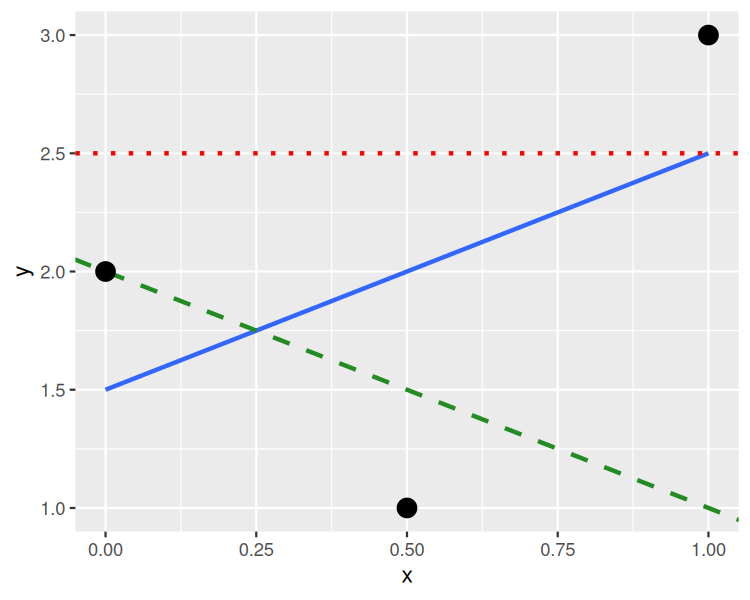
Compute the sum of squared residuals by hand for each line. Show that the regression line in blue has the smallest value of these three lines.
Answer.
The regression line in blue:
\begin{equation*}
\sum_{i=1}^{n}(y_i - \widehat{y}_i)^2 = (2.0-1.5)^2+(1.0-2.0)^2+(3.0-2.5)^2 = 1.5
\end{equation*}
The arbitrarily chosen dotted red line (horizontal at \(y = 2.5\)):
\begin{equation*}
\sum_{i=1}^{n}(y_i - \widehat{y}_i)^2 = (2.0-2.5)^2+(1.0-2.5)^2+(3.0-2.5)^2 = 2.75
\end{equation*}
The arbitrarily chosen dashed green line (\(y = 2 - x\)):
\begin{equation*}
\sum_{i=1}^{n}(y_i - \widehat{y}_i)^2 = (2.0-2.0)^2+(1.0-1.5)^2+(3.0-1.0)^2 = 4.25
\end{equation*}
As calculated, \(1.5 \lt 2.75 \lt 4.25\text{.}\) Therefore, we show that the regression line in blue has the smallest value of the residual sum of squares.

